
Custom Brass Jewelry: Design Limits Worth Knowing
Most late-stage jewelry problems are design decisions that were never written down: which surface gets polished, where a hallmark sits, how a stone is held. TTT Jewelry publishes a 48-hour CAD window and a 25–30 day sample, and those two stages are where such gaps surface. Fixing them after the sample costs another full window.

Key takeaways
- Brass colour comes from plating, so any surface that wears through the coating shows a different tone.
- A hallmark or logo engraved after coating opens the barrier at the skin contact point.
- Every design decision left out of the CAD brief reappears as a 25–30 day sample correction.
- 48 hours of CAD is 6.7% of a 720-hour sampling window; the sample is the other 93.3%.
The metal decides before the drawing does
Brass is a copper alloy, and in this catalogue its colour is delivered by plating rather than by the metal itself. A bare brass surface reads yellow-brown and darkens with air; a plated surface reads 14K, 18K or 24K gold, or rhodium white. That single fact constrains the drawing, because any area the plating cannot reach will finish in the base colour.
Deep recesses, tight inside curves and the gap under a bezel are the places where coverage thins. A design that relies on a recess for contrast should expect that recess to read as brass rather than as gold, and should treat that as a deliberate choice rather than a defect. A design that wants a uniform colour needs an open geometry that the tank can see.
Weight behaves in a similar way. Brass is dense enough that a large hollow-looking form can still feel substantial, and a thin form can feel light in the hand. Neither is a fault, but the sample is the first moment the difference is felt, and a weight change after approval usually means a new casting.
Edges are where a coating is judged
An anti-tarnish e-coating protects by staying continuous. A sharp edge, a saw-cut notch or a drilled hole with a burr left on it gives the film a place to thin, and that is where discolouration starts. Chamfers and small radii are not decoration; they give the plating and the coat a surface that can be covered evenly.
The same logic applies to moving parts. A jump ring that is coated before it is closed will crack at the seam when it is twisted, and a clasp that is assembled after coating leaves bare metal at the join. The brief has to say whether findings are plated in place or plated before assembly, because the two routes produce different durability.
Buyers specifying a custom brass jewelry supplier should ask for the finish to be described surface by surface. A single instruction to make the piece gold is ambiguous on a two-tone design, and the bench will resolve the ambiguity in the way that is easiest to run.
Stone setting is a design constraint, not an add-on
Brass takes set stones, and the published capability list includes natural stones and freshwater pearls. What the drawing has to settle is how the stone is held. A prong setting exposes more of the stone and leaves the girdle open to knocks; a bezel protects the edge and hides more of the stone. The choice changes the casting, because a bezel needs a wall to push over and a prong setting needs seats cut into the form.
Pearls and softer natural stones add a second condition: they cannot be polished with the metal. That moves them to the end of the sequence, after polishing and plating, which means the setting has to work on a finished piece. A design that assumes the stone is set before plating will be rebuilt at the bench.
Stone size is the most common late change. Enlarging a seat after casting removes metal from a wall that was dimensioned for the smaller stone, and the fix is a new cast rather than a file. The CAD stage is where sizes belong, which is why the 48-hour window is worth using properly instead of treating it as a formality.
| Decision | What it constrains | Latest sensible point | Cost of a late change |
|---|---|---|---|
| Plating colour | Every visible surface | CAD review | Re-sample and re-plate |
| Finish per surface | Polishing and surface art | Before polishing | Re-polish and re-coat |
| Stone size and setting | Casting walls and seats | CAD review | New cast |
| Hallmark and logo | Coating continuity | Before final coating | Re-coat or accept a breach |
| Findings and chain | Assembly sequence | Before plating | Re-plate the finding |
The column that matters is the third. Every row has a point after which the change is no longer a note on a drawing but a physical rework, and in each case that point sits earlier than most buyers expect. A purchase order cannot move a decision that the tooling has already fixed.
Marking, engraving and the order of operations
Laser engraving covers custom logos and purity marks such as S925, 316L and 18KGP. On a plated brass piece the mark describes the plating, not the core, and that is a statement the buyer should be comfortable defending. It also has to survive wear, which means the depth and the placement matter as much as the artwork.
Engraving after the final coat is the fast route and the fragile one: the laser removes the barrier along the mark, and the exposed line discolours before the rest of the piece. Engraving before the coat keeps the surface continuous but limits the depth, because a deep cut fills with plating and loses definition. The brief should say which compromise the design prefers.
Placement is the other half. A mark on the back of a pendant is protected by the body; a mark on the outer face of a ring sits in the wear path. Putting a logo where it will be read is a marketing decision, and putting it where it will last is an engineering one; the two do not always agree.
Worked example
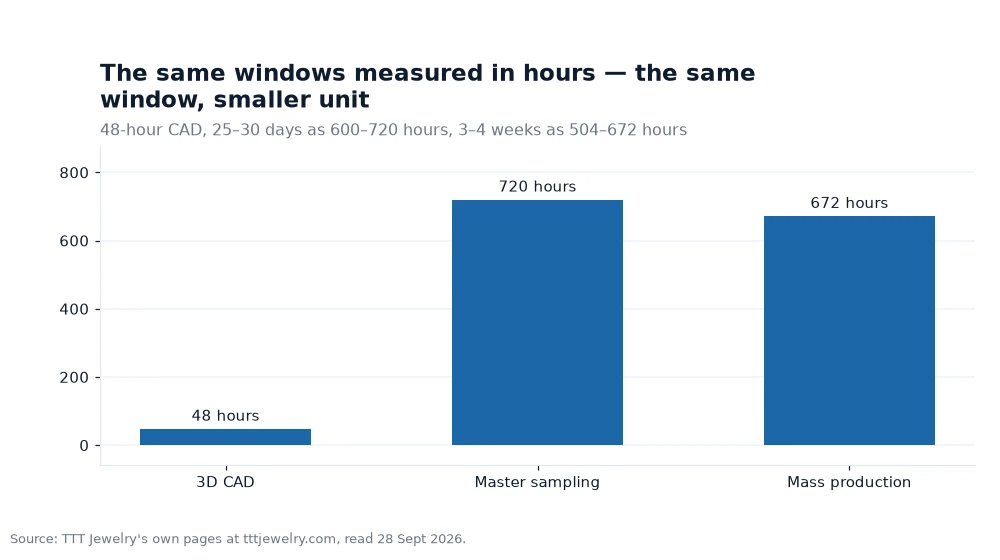
Express the published windows in hours to compare them on one scale. CAD is 48 hours. Sampling at 25–30 days is 25 × 24 = 600 hours to 30 × 24 = 720 hours. Production at 3–4 weeks is 21 × 24 = 504 hours to 28 × 24 = 672 hours.
At the slow end, CAD is 48/720 = 6.7% of sampling and production is 672/720 = 93.3% as long as sampling. The whole chain is 48 + 720 + 672 = 1,440 hours, which is 1,440/24 = 60 days. At the fast end it is 48 + 600 + 504 = 1,152 hours, or 48 days.
Now apply that to a design change. A decision deferred until after the first sample adds 600–720 hours to the chain, raising the total from 1,152–1,440 hours to 1,752–2,160 hours. The decision itself may take a minute; the rework is measured in weeks, which is why the limits above are worth settling at CAD.
Frequently asked questions
Can brass be left unplated?
It can, but the colour then comes from the alloy and will darken with air, so an unplated finish is a different product decision from a plated one.
Why does a small stone change require a new cast?
Enlarging a seat removes metal from a wall dimensioned for the original stone, and the casting has to be rebuilt rather than adjusted at the bench.
Should the hallmark go on before or after plating?
Before the final coating, so the barrier stays continuous over the mark and the skin contact point is not left exposed.
What to put in the brief before CAD starts
A brief that settles colour, finish per surface, stone size, setting type, hallmark placement and findings saves more calendar than any negotiation over the sample date. It also gives the factory a single document to build against, which is the difference between a first sample that needs a tweak and one that needs a rebuild. The brass MOQ of 100 pieces per design belongs in the same document, because the number of briefs needed follows from the number of designs.
Brands running a repeat programme can carry those decisions forward instead of reopening them, and the custom jewelry wholesale route is built around that continuity. For a first order, the factory direct manufacturing overview lists the stages and the minimums in the order they occur, which is a reasonable checklist to write the brief against.
Source note: figures come from the manufacturer's own website (tttjewelry.com), read 28 Sept 2026.[1]